
2025 was my worst year for airdrops (what didn’t work for me)

Everyone’s posting their biggest wins of the year, so I’ll do the exact opposite.
We were promised so much, but it has been the most underwhelming year since I started airdrops in 2023.
I’m writing this on the final day of the year to remind myself of all the painful lessons I learnt to refine my strategy in 2026:
Onchain
Grinding mindless tasks
I still continued with the old strategies that worked well for me in the previous years, including completing Galxe and Layer3 campaigns.
But the returns are getting worse, and they have become huge time sinks.
Sometimes, I’m even forcing myself to interact with projects where the UX is horrible, just to get a token that I’ll dump instantly.
A prime example is Eclipse, where most of the apps were either clones of whatever we could find on Solana or memecoin launchpads/games.
I grew tired of interacting with the ecosystem, and I’m glad that I cut my losses without spending too much time and capital on this L2 (which decided to reward their ‘community’).

Campaigns have turned into a job (but without any guaranteed returns), and most are just a waste of time.
I’ve adopted this mindset when interacting with any project:
If it doesn’t energise me or I’m forced to grind, I will skip it.
Judgment becomes the most important skill to determine which projects are worth interacting with.
Skipping perp DEX airdrops
Lighter cooked for those who were active, while I earned an amazing 3.9 points.
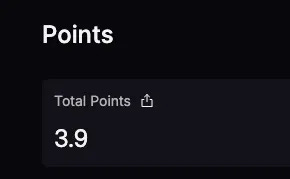
Trading is not for me, and I’ve barely touched any of the perp DEXes (or even prediction markets for that matter).
It’s no longer the meta of burning fees for points and hoping to get a good return from the airdrop, because everyone else is doing the same actions until the pool gets overdiluted.
I’m skeptical now when every other new airdrop seems to be a perp DEX or a prediction market. Do we really need so many platforms when they essentially perform the same function?
Would someone still use Variational and all the other new DEXes after they gave away their airdrop?
Or maybe, it’s just me being ignorant, and the features they have are not catered to me.
I’m still in the camp that such speculation is gambling, but I plan to learn some strategies to manage my risk better.
Ultimately, I want to make profits first through the platform, and get the airdrop as a bonus.
Relying on just the airdrop alone for profits no longer works.
Risking funds unnecessarily
2025 was the year of new stablecoins. But no matter how safe they claim to be, there’s always the risk that they would depeg.
Even with all the hype (though likely most could be from InfoFi campaigns), Solstice faced major liquidity issues during the underwhelming presale.


It’s not worth risking your capital just for an airdrop, and I don’t see a point in interacting with most of these campaigns which follow the same style (points for holding stables and deploying them in DeFi positions).
I still plan to gain some exposure in certain stablecoin airdrops with Pendle YTs, which still have their risks, but at least I’m not risking significant capital.
2025 was also the year of DeFi hacks, with Balancer and Stream Finance being the major ones that affected us.


Multiple platforms had exposure to Stream Finance, and this was a good wake-up call for me on how risky lending platforms like Morpho and Euler can be.
And of course, I lost $13k from a stupid mistake by using Google to find the Plume Portal which led me to a phishing site instead.
It was all because I was using another device to sign my transactions, so the browser history was completely new.
This is the perfect example of how hardware wallets are not completely foolproof, and we can still get hacked by signing malicious transactions.
Though I’d still use them because they protect against seed phrase exploits like what happened during the Trust Wallet hack.
FOMO-ing without thinking
One of the bigger mistakes I made was deciding to FOMO into football.fun. I thought that because of my background in football, this would be something that I could do well in.
After the hype back in August, I decided to buy player shares when it crashed slightly. But it had gone downhill ever since.
I underestimated the amount of commitment it required, especially to monitor the players’ prices. I’ve lost the motivation to continue checking my players during the different tournaments, and my team is slowly rotting away.
This was a good reminder to research thoroughly into something and ignore all the shills on the timeline before deciding to go into any project.
Though I’m glad I didn’t FOMO into launchpads and barely participated in most of them, as they seem to be underwhelming.
Social
Choosing not to yap
I am the biggest fool for choosing not to yap when it was so easy to print money during the early stages of InfoFi.
All we needed was to plaster a project’s name on every single tweet and we get a nice fat paycheck when they TGE.
Some have called me stupid for not adapting to the ‘meta’, but I couldn’t bring myself to talk about a project when there’s just nothing much to say.
Till this day, it’s cringe how some are trying to farm engagement while adding a project’s name at the end of the tweet just to increase their mindshare.
I’m choosing to sacrifice short-term profits for long-term wealth, and we’ll see if that was the right decision in a few years’ time.
In this age of infinite content, a trusted personal brand is something that will make you algo-proof and Sybil-proof to continue standing out.
I’d rather be a depth yapper to build out my reputation instead of mindless dopamine yapping that just creates noise.
Caring too much about views and other vanity metrics
The algo has completely changed from last year, and my views have plummeted.
My follower count has been stagnant for the past 3 months.
No matter how I tell myself to ignore it, the lower metrics have taken a toll on my confidence.
This was the year when I burned out multiple times, as my main motivation was the number of views I’d get.
Virality and dopamine got into my head, and the performance of my previous articles was a good reminder of how unpredictable the algo can be:
These could not even go past my baseline of 10k views, while my most recent article received 50k views.
There’s no way to know how the algo or my followers would react to any of my content, unless I post it.
And the only way to stop caring about the performance of one piece of content is to post it, and then move on to focus on the next one instead.
That’s why I believe in finding a way to capture ideas so that we’ll never be stuck at staring at a blank screen, wondering what to write next.
Instead of focusing too much on views, I’m looking for resonance with my audience.
If what I write makes a reader feel something, I have achieved my goal.
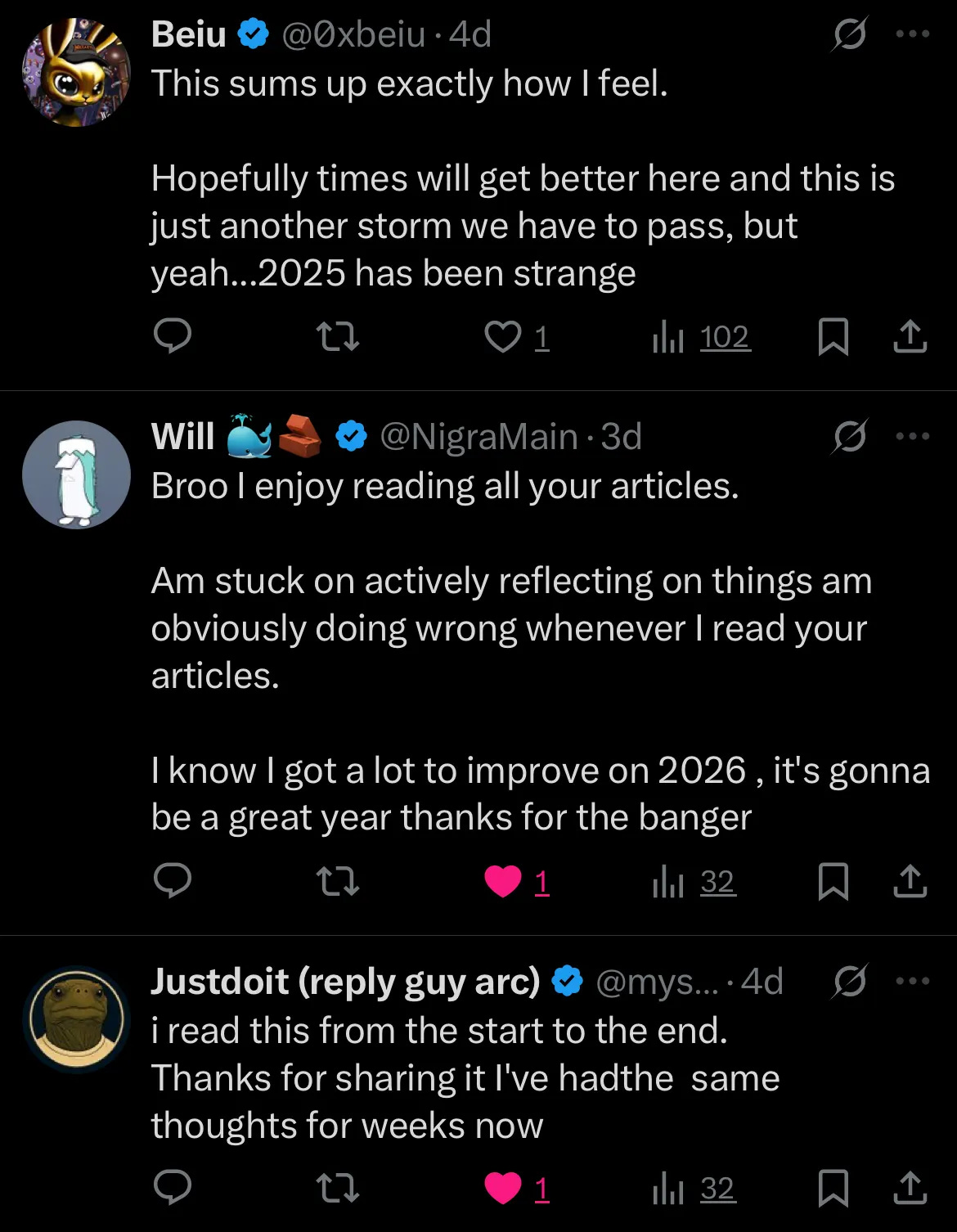
Others will remember how you make them feel. And I’d rather have a strong connection with a smaller group than to have a weak connection with thousands of followers who would forget me easily.
Using generic images for my articles
I wanted to save time and use a template for my article header images, because I believed that the content would be good enough to get others to read more.
But this could have led to others on the timeline ignoring my new articles, because the cover image looks exactly the same as the one they just read.
While it takes up more time, I’m looking to adopt some of the minimalistic elements from @visualizevalue to summarise my article in a simple graphic.


This has varying results so far, but I’ll continue refining the ideation and execution process to create graphics that can capture attention.
Not telling more stories and sharing more failures
With how toxic CT can be, I was scared of sharing my stories here.
As an airdrop account, I was pressured to only share my wins, because everyone else seems to get massive wins with every airdrop.
Why would they follow me if I keep failing?
But my mindset changed when I decided to share a bit of lore about my username.
I thought others would judge me, but the responses was encouraging as my audience got to know more about me.
Of course, there will be those who still call me a ‘loser’ since I keep failing.
But no one is perfect, and sharing failures actually help others to trust your wins more.
Instead of those who share their wins, which may not even be true.
Not connecting with my audience more
I haven’t checked my notifications for weeks, as I’m still slowly recovering from yet another round of CT burnout.
Sorry btw if I haven’t replied you yet, please shoot me a DM if there are any questions you still have.
In 2026, I’ll be looking to strengthen my connection with my audience, especially those who have been with me since I started on CT.
I co-hosted my first Spaces with @0xbeiu, and it was nice to see the encouraging turnout for our chat.
Connection with my audience will be the key to staying algo-proof, and there’s so much we can build through just text alone (which is why audio and even video are areas that I want to explore).
We’re looking to do more of these in the future as a bi-weekly event, and let us know if there are any topics that you’d like to discuss.
General
Wasting time
I wonder how many weeks I’ve wasted this year, scrolling mindlessly on the timeline and justifying that I’m finding alpha while consuming noisy content.
Time is our most valuable asset because it can never be earned back, and I’m looking to be more intentional with how I spend it.
I’ve successfully kicked the habit of constantly checking my notifications, and I want to reduce the amount of time I spend on Twitter and other social apps.
That’s why curating our feed becomes so important to remove noise, and I’m glad that the timeline is healing with more long-form content being shared now.
Comparing with others
This has caused me a lot of unnecessary stress, and I’ve wasted so much time thinking about others.
There will always be someone better than you:
Someone grows their follower count faster than you
Someone gets a higher airdrop allocation even when they put in less effort
If we compare with others, we will never be happy.
Even if we get a good win, we’ll see others doing even better than us and that spoils the entire mood.
But everyone is running their own race, and the only person we should compare with is our past self.

I would be most worried if my growth was stagnant, so I would aim towards learning and honing my judgment to get better at airdrops
Not using metrics to drive my decisions
I’m horrible at maths and numbers, so data is not something that I enjoy looking at the most.
But with AI making it easier to analyse and gather insights, this is one change that I aim to make for 2026:
Look at data to gain a clearer picture on the projects that I’m interacting (or want to interact) with.
There’s only so much information we can get from CT. It’s possible that the data that is posted here may not even be true, and I want to be more proactive in finding these sources myself to make my own decisions.
What worked for me
While it seems like such a depressing year, there are still positives to take with me into 2026:
Choosing to write long-form
I made a commitment to writing long-form every week, and that has helped me to gain more clarity in airdrops.
While I’ve stopped writing guides (which I’m doubting their effectiveness), I’ve realised the need to express my opinions more, which will help me stand out from the masses.
I’ve seen many accounts posting the same airdrop updates, and all of them will become commoditised by AI (because they can pump out such content at scale).
Long-form is still the best way to build trust, because it adds depth to our ideas and those who resonate will see the true value in them.
Building a reputation
2025 marked a turning point in how I viewed airdrops, especially after reading Vitalik’s post on why reputation will be so important.
Airdrops are essentially a war against Sybils, where low-value actions are ignored because they are replicated at scale by Sybils until they lose their meaning.
And in 2026, I’m going all in on building a unique reputation for myself. Not just as the typical airdrop guide creator, but someone who’s able to filter out the noise and spot the best opportunities.
I’ve seen how both my onchain and social footprint have helped me qualify for different airdrops, including MegaETH’s allocation (even though I barely talked about them here).
And if you believe in the same principle, then the easiest way is just to say what you did onchain.
2026 is a new start
2025 was a crazy year, with Trump and all the noise from InfoFi.
But I see 2026 as the year for healing, as platforms start to combat noise and the focus goes back to revenue instead of all those projects that generate hype but disappear after TGE.
It has been a tough year for me, and I hope that it was better for you.
But thank you to all who have been through this journey with me, and 2026 will be our year.
If you are tired of burning out by grinding mindlessly for airdrops, there is another way.
To earn rewards automatically just by being yourself, build a reputation that compounds by joining the 30-Day Signal Creator Challenge.