
I’m giving up on airdrops (AI killed my edge)

Airdrops are no longer about who can click the most buttons, because AI can do that better and faster than any human.
I’ve completely lost my edge in airdrops because my entire strategy involved low-value actions that can be copied at scale.
No matter how much effort and time you put into grinding, the outcomes you get will be far worse than what you expect.
I’ve been too focused on grinding harder when I should have gone all in on learning how to work smarter.
So I’m completely revamping my airdrop strategy and adapting to this new normal with AI:
Airdrops are so boring now
2025 was the worst year I had for airdrops. Throughout the entire 12 months, I burnt out at least 3 times because I was aimlessly grinding on both my social and onchain footprint.
I spent the day looking for tasks to complete, and airdrops turned into another job for me, while not giving me a good ROI on my time.
And not forgetting InfoFi, which became the worst plague that could possibly happen to a space that was already filled with the farming mindset.
The old projects threw money at us for:
Grinding out simple social-based tasks or testnet campaigns
Completing Galxe or other campaigns that had zero barrier to entry so anyone could participate
The Arbitrum airdrop was the turning point because everyone expected every other L2 to use the exact same criteria.
Which is impossible since anyone can spin up bot farms so hundreds of wallets can meet the criteria, or what I call the Sybil war.
Projects continue farming us because they know there won’t be retained users if there’s no hint of a token.
So they spin up endless campaigns and point programs to give us dopamine hits so we continue interacting.
There are too many teams with shady practices that come up with ‘Sybil detection measures’, only to reward all the tokens to themselves.


And of course, there are KOLs who hype up the airdrop raise expectations to unrealistic levels that eventually are not met.


That model of airdrops is dying. It no longer works in this age where low-value actions can be easily replicated by AI.
I’ve completely lost the motivation and fun in hunting airdrops. I’ve realised that 90% of the projects that I farmed will be ones that I’d never touch again.
The only reason why I used it was for the token, and not because it was genuinely useful in helping me achieve a goal.
Now, when I look at the timeline, I struggle to find new projects I should be interacting with.
While airdrops have taught me a lot of DeFi skills that I would never have touched, there’s nothing exciting to me now.
Maybe because I’m a horrible trader that loses money all the time, so all of the new perp DEXes never appealed to me.
I’ve made the mistake of pumping up volume while burning fees, and eventually get a low ROI based on my time and capital.
So, will this be the death of airdrops? I don’t think so, it’ll just evolve into a new model:
Reputation, judgment, and curiosity still matter
Most of us are stuck in the hamster wheel of airdrop farming.
We wake up, put in the work, and hope that we get a good return. We wait for someone to spoon-feed us alpha and we follow it diligently, but it gets diluted the moment it’s shared.
If the only skill we have is knowing how to do things, we will be made irrelevant by AI.
Everything with a workflow can be done autonomously, so what edge do we have anymore?
This was something that cost me my job, and there are 3 main moats that I see to stop us from getting replaced:
Reputation
The biggest revelation I had last year was how reputation is the moat for Sybils. What you do onchain and what you say online build out your brand.
That brand is what makes you stand out from Sybils. It proves that you’re a high-value individual who deserves rewards, and not just another Sybil with spammy transactions and AI-generated posts.
We’ve seen how @ethos_network is focusing on peer-to-peer human verification as the next defensible layer against Sybils, or [ ] as a new social network that is based on social capital.
The trust recession is the greatest opportunity we have to stand out by actually doing things and sharing about what we did.
Once both our social and onchain profiles match, it gives a greater reason for someone to trust us.
Because too many accounts are making outrageous claims without the proofs to back them up, we start to trust them less (even if they get tons of engagement).
Your reputation gives you access to information and opportunities, so guard it with your life.
Focus on giving value instead of extracting whatever you can through quick cashgrabs and paid shills.


If you’re here for the long run, being patient gives you outsized returns.
Judgment
Oversensationalised news is everywhere.
Everyone is telling you:
AI is stealing your job
The middle class is disappearing because of automation
You have a few years left to escape the permanent underclass
But most of it is just noise that should be filtered. And how you let that affect your emotions will determine your success.
We are in the age of doing, where anyone can tell AI what they want to build, and it spits out something for us.
Right now, the limiting factor is time. I have so many ideas on what I want to do, but I have no time to do them all.
Judgment helps us determine the highest-ROI actions we should complete with the limited time we have.
Judgment lets us find signal in the sea of noise, so we follow the right people that actually leads the life that we want to have (and not just any plain old larper).
So focus on honing your judgment and building your signal-to-noise filter through these 2 steps:
Be extremely deliberate with the content that you consume (and curate your feed aggressively)
Constantly reflect on your results (both wins and failures) as the biggest signal you get is from the actions you do
Curiosity
With all the information in the world available at our fingertips now, there is absolutely no reason why you should say that ‘you don’t know’ how to do something.
Being open-minded and trying new things was the principle I adapted to my airdrop strategy, and it’s one of the most important skills today.
Though it needs to be paired with judgment so you know what to explore further and what to skip.
The AI boom has taught me that staying with the status quo is the fastest way to lose out.
As a crypto user, I had access to all the agentic tools long before the current crowd, but I didn’t explore further because I thought I was ‘bad at coding’.
But even right now, it’s not too late.
Too many are stuck in the loop of consuming instead of creating. They prefer to explore through others’ experiences instead of creating their own.
And once you break out of that cycle, you’re already in the top 1%.
This chart shows just how far ahead you are of others, once you take that first step and pay for an LLM subscription.


And it’s not too expensive either, I’m using GLM-4.7 and it costs me $10/month. You don’t need to use the frontier models like ChatGPT or Claude, other cheaper models can provide considerable outputs too.

And right now, you can build literally anything. You just need to tell AI what you want to build, and it’ll do exactly that for you.
The more specific the instructions we give to AI, the better the output. It’s not something where anyone can one-shot an amazing product, which is only possible for power users.
While for the rest of us who have zero coding experience, getting better with AI comes through constant iteration, instead of just giving up.
Staying curious and wanting to learn more gives us an edge over the average passive consumer.
What I’m doing now
My account has been fully focused on airdrops, but that will change.
Over the past 2 months, I’ve been extensively playing with AI when I was on hospitalisation leave, and this has helped me understand its capabilities better.
These were the most difficult barriers I faced:
Getting everything set up the way I want (I took 5 days for my OpenClaw stack)
Connecting to different APIs (some like Google are so frustrating to generate the API keys)
Managing token burn (spamming questions is the fastest way to reach your rate limits)
And right now, here’s how I’ve set up my OpenClaw (as an Arsenal fan):
Arteta: Manager and overseeing the operations of the other 3 agents
Saka: Running my personal brand with content ideation and social listening
Dowman: My job hunt assistant to find opportunities for me to apply to
Gabriel: My wallet tracker and alpha hunter, will probably give him a wallet soon to optimise for profits
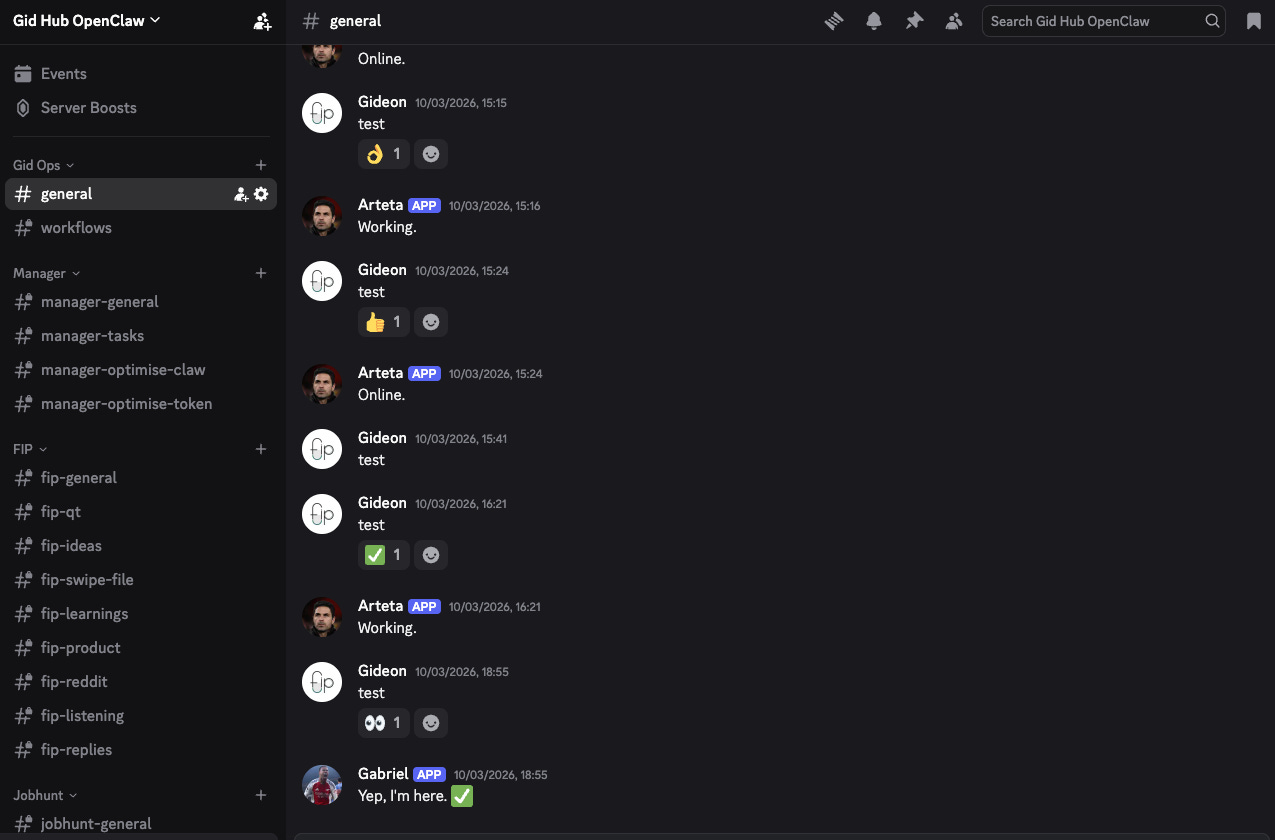
These are the functions that I want to automate in my life, and I’ll be sharing how I set them up along with other guides on efficient token usage and more.
So if you want to learn how to integrate AI into your social/onchain workflows, stay tuned for more posts in future.
Get out of the high-noise, low-agency loop
Those who get left behind are the ones who consume instead of creating something meaningful.
Airdrops have been a painful lesson, where I was stuck in the grinding loop that started giving poorer returns because of overdilution.
But with AI, I now see how I can compress time to explore new strategies (both onchain and social), get results, and then iterate to improve my strategy.
And I strongly encourage you to take that first step and use AI to create anything.
Find one task that you hate doing and outsource it to AI to get it done.
And once you become confident with that workflow, start to scale up and continuously solve problems you face in your life.
Once you see AI in this light, you’ll notice that it is just a tool, just like the Internet. It compresses your time by removing all the boring automation from your life.
If there’s a best time to adopt AI into your workflows, it’s now.
So start taking action, and start changing your life by becoming AI fluent.
You don’t have to be overwhelmed by AI.
If you want to work with me to build your AI fluency and stop your fear of falling behind:
Fill out the questionnaire below and I’ll reach out to you: