
The surprise airdrop that you don’t need to actively farm

Not all airdrops require grinding, and those are often the best ones.
I’ve tried different types of airdrops, and many have burnt me out.
But I’ve realised that the smartest way to get airdrops is to not farm them.
Here’s what I’m doing instead to get the highest rewards ‘by accident’ with the least effort:
We get rewarded by being active onchain
Not every project would, but some allocate airdrops to active onchain users.
Here are some examples of previous retroactive airdrops:
Awarded Cosmos eco stakers, active L2 users
Awarded active L2 users, including Starknet
Awarded wallets with strong Ethereum and Solana activity
SBT eligibility was based on our onchain contributions
Awarded significant traders and depositors of top Ethereum and Solana protocols (who they defined as giving significant value onchain)
Following @Zeneca’s philosophy for airdrops, we’ll get them just by being open-minded and exploring new things onchain.

Our footprint lets us qualify for different airdrops just by interacting with protocols we like.

No one knows the criteria
Point programs with known criteria are boring because the project tells you how to actively farm them.
One of the most ‘infamous’ project is MarginFi, who ran a points program for months (maybe years?) without announcing any token.
But that’s the catch with any point program:
No one promised you anything and the campaign can go on forever.
They can change the rules whenever they like, and that’s the game we’re playing.
Many will get frustrated if their only aim is to grind the project for the airdrop.
When we place too much expectations on the airdrop for rewards:
We will be massively disappointed.
Such programs will also be heavily botted by Sybils, which dilute the allocation even more.
Meanwhile, retroactive airdrops won’t publicly share their criteria.
We can contrast between the criterion that 2 different L2s used:
Both used a similar factor (liquidity) to determine the eligibility.
But Scroll didn’t do well except for whales, while ZKsync was a good cook if you played your cards right.
Many are still outraged that they’re ineligible for ZKsync, but we would have qualified even with a small amount of capital.
We have less competition
No one likes to farm airdrops when there’s so much uncertainty.
The best scenario happens when projects do a Base or Arbitrum:
Actively deny that they won’t launch a token, until they change their minds and decide to launch one.


So fewer wallets would be active participants because those who are just looking for the incentives won’t participate.
Or they’ll give up halfway because farming the project doesn’t make sense from an ROI perspective.
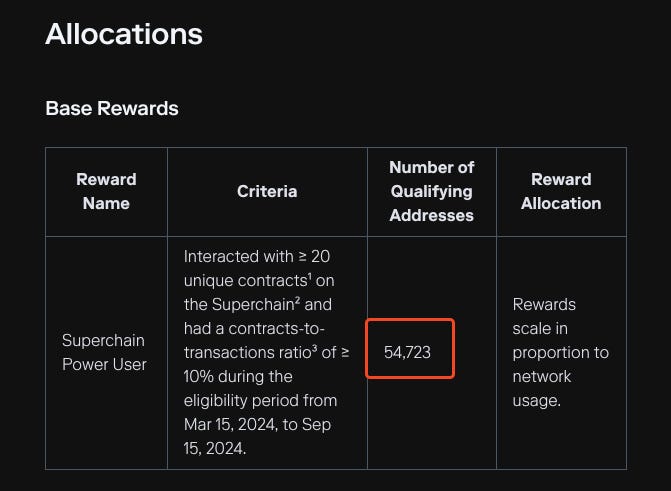
Optimism’s airdrop #5 came as a big surprise to me, and it turned out that only 54,723 wallets qualified for it.
Many will sit on the fence and ask if it’s worth interacting if there are no guarantees.
But the real reward comes from uncertainty:
We risk our time and capital based on our convictions, which could be a failure or one that pays off handsomely.
Even if we meet with failures, this helps us refine our strategy further and know what to avoid in future.
We don’t get burnt out
I’ve been asked so many times what the best projects are to farm.
We are always looking for the next farm, before dumping and looking for the next one.
But sometimes, the best airdrop play is just using what you enjoy.
Who would have known that being active on Aave or Uniswap would have given us the Monad airdrop?

I’ve experienced burnout multiple times by constantly searching for the next alpha.
But if we can get rewarded based on our onchain footprint:
The real alpha is interacting with protocols that we enjoy using and can profit from along the way.


Focusing too much on the end result leads to disappointment.
While getting surprise airdrops will keep us motivated to continue exploring onchain.
Sybils can’t game the system
Sybil farms pretend that they’re real humans by doing the bare minimum to be eligible.
There will always be Sybils who try to extract from a project.
But projects that use retroactive criteria are able to tweak it to remove Sybils.
Of course, these are never perfect:
Real users will get filtered out
Some Sybils will get allocations
Is hard to balance between the 2, and there will always be someone who gets left out.
On our end, we can do our best to not be filtered out as a Sybil and be ineligible for airdrops.
And it all starts with this principle:
Value is the main criterion
Retroactive airdrops are distributed based on the value that your wallet provides.
Monad described this as ‘addresses that have historically generated significant value onchain, across different value forms’.
If we’re doing the same low-value tasks as a Sybil:
We will be labelled as one and be ineligible for the drop.
Projects won’t want to reward those who spam the same swaps multiple times.
Instead, they would reward high-value contributions.
But there is no strict rule for this, and projects get to decide what actions they want to reward.
So to qualify, all we need is to find apps that we enjoy and use consistently.
Our footprint will be recognised by other projects and we’ll get rewarded for using the apps we like.
Build a strong onchain and social footprint
Onchain footprint has been declared dead by many people, but I still believe that it plays a key role for future airdrops.

Even if airdrops now are heavily skewed towards social allocations:
Onchain footprint still forms the basis of trust for your social reputation.
Others can tell when you’re faking or being inauthentic, so there’s no point in trying to lie.
All you need is to say what you did onchain to increase your luck surface area.
I shared more about this below:
If you are tired of burning out by grinding mindlessly for airdrops, there is another way. To earn rewards automatically just by being yourself, build a reputation that compounds by joining the 30-Day Signal Creator Challenge.